 +38 050 933 51 60
 +38 093 369 29 10
A strong bench press, a stable deadlift, confident progress in the squat – these are not questions of a single “magic” product. Sports supplements for strength work when they enhance an already well-established system: training, sleep, nutrition, and recovery. That is why it is important to understand not only what to buy, but also why a specific formula is needed by your body and your type of workload.
Which sports supplements for strength make the most sense
If you strip away the marketing noise, there are several categories for strength indicators that truly deserve attention. They do not replace discipline, but they are capable of noticeably impacting performance in the gym, the quality of repetitions, and the speed of recovery between heavy sessions.
Creatine – the baseline for strength progress
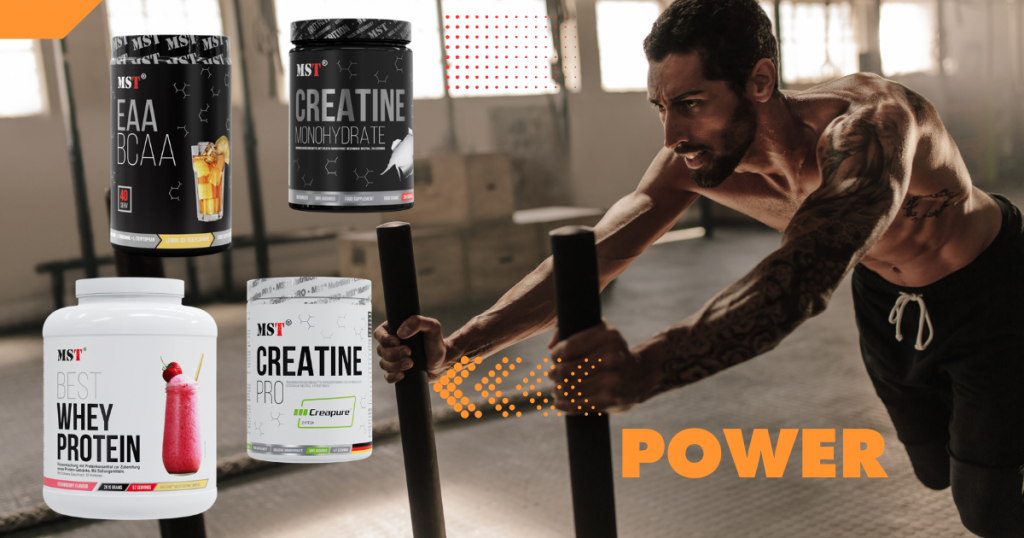
When it comes to strength, creatine is almost always at the top of the list. The reason is simple: it supports the resynthesis of ATP – the primary energy source for short, explosive, and heavy efforts. It is exactly these efforts that determine the outcome in basic exercises, sprints, explosive movements in crossfit, martial arts, and weightlifting.
For most athletes, creatine monohydrate remains the optimal choice. This is a form with a robust evidence base, predictable action, and a good balance of price and effectiveness. Not everyone will experience an instant “wow” effect, but after a few weeks of regular use, working power frequently increases, endurance within sets improves, and it becomes easier to maintain training volume.
There is a nuance here. If a person trains chaotically, under-eats, or sleeps for five hours, even high-quality creatine will not salvage the outcome. But if the baseline is in place, this is one of the smartest investments in strength progress.
Pre-workout complexes – when focus and explosiveness are needed
Pre-workout formulas do not build strength directly in the way that creatine does. Their role is different: to raise concentration, improve readiness for the workload, and give a better start to a session, especially if the workout takes place after work, in the morning, or during a period of accumulated fatigue.
In a good pre-workout, it is not loud promises that matter, but the composition. Caffeine can enhance alertness and the subjective feeling of energy. Beta-alanine is often used to support performance in high-intensity modes. Citrulline is added for better blood flow and a sense of productivity in the gym. For a strength athlete, this means a simple thing: a well-assembled formula helps to enter the workout better and prevent a drop in intensity.
But not everyone needs a powerful stimulating complex. If you have a sensitivity to caffeine, sleep issues, or train late in the evening, an aggressive pre-workout can harm recovery more than it helps a set of six repetitions. Individual tolerance is what matters here, not chasing after the “hardest” product.
Protein – not for strength itself, but for the muscle baseline
Strength grows not only through neural adaptation but also through the development of muscle mass, especially over a longer distance. That is why protein cannot be placed in the same line as stimulants – it is rather a tool that helps cover the daily protein requirement and consistently support recovery.
If you already obtain enough protein from food, sports protein powders are not mandatory. But in practice, it is difficult for many athletes to meet their norm daily, especially with a busy schedule. In such a situation, whey protein is a fast, convenient, and predictable solution. It does not provide strength “here and now,” but it creates the conditions under which the body adapts better to strength workloads.
Amino acids and EAAs – appropriate, but not always first
Amino acid products are often bought sooner than they are actually needed. If the budget is limited, they should rarely be the first choice for building strength. First, you should secure the baseline: creatine, sufficient protein, quality nutrition, and sleep.
However, EAAs or individual amino acid complexes can be useful in certain scenarios. For example, during fasted training, in a cutting period, with a reduced appetite, or when there are large gaps between meals. In such cases, they help to manage recovery better and reduce the risk of a drop in performance. But you should not expect the same strength effect from them as you would from creatine.
What else affects strength besides core supplements
Strength results do not exist in isolation from the general state of the body. If an athlete regularly under-recovers, has micronutrient deficiencies, or suffers from joint overload, progress will be hindered even with a great program.
Omega-3, vitamins, and minerals
These products are rarely bought for an immediate weight increase on the barbell, but they are exactly what often builds the foundation for stable performance. Omega-3 can support overall recovery and comfort during periods of heavy workloads. Magnesium is crucial for neuromuscular function. Vitamin D, zinc, and other micronutrients also matter, especially if deficiencies are present.
Simple logic applies here: a body that does not cover its basic needs will not show its maximum in strength. Therefore, champions recommend looking at sports nutrition not as a random set of jars, but as a system for supporting results.
Joint and ligament support
For those who regularly work with heavy weights, the topic of joints is not secondary. The longer you train seriously, the more valuable not only peak strength becomes, but also the ability to handle workloads for months without forced pauses. Formulas for joint support, collagen products, and ligament complexes can be highly appropriate if the volume of work is high or if a feeling of overload is already present.
This is not a story about an instant record. It is a story about a long distance where the flawless quality of recovery often decides more than a one-off spike in motivation.
How to choose supplements for strength without making mistakes
The most common mistake is buying based on the principle of “what is currently trending.” Strength tasks vary. A powerlifter, a crossfitter, an MMA fighter, and a person who simply wants to add 10 kg to their bench press have different training contexts and different priorities.
First, you should honestly define your goal. If the main task is to increase strength in basic movements, it is logical to build the start around creatine and a normal protein intake. If the problem lies in sluggishness before a workout, a pre-workout complex would be appropriate. If you frequently “break down” due to a high volume of work, you can additionally look into recovery, omega-3, magnesium, and joint support.
The second criterion is composition and formula transparency. A product should inspire trust not through its jar design, but through clear ingredient dosages. That is why an audience training for results values the German approach to manufacturing so highly: control, precision, purity of raw materials, organic ingredients where appropriate, and the absence of chaotic solutions in formulas.
The third aspect is tolerance. What works wonderfully for your coach or gym partner will not necessarily suit you. One athlete responds excellently to stimulants, while another gets anxiety and poor sleep. One tolerates large portions of protein well, while another prefers a smaller dose or a different form. A strong result is always built on a personalized approach.
When to expect an effect and what not to expect
In strength supplements, it is important to correctly evaluate the result horizon. A pre-workout can be felt on the day of intake. Creatine typically reveals itself through regular use. Protein works not as a stimulant, but as part of a daily strategy. Vitamins and joint support are also not designed for an instant effect.
Another crucial point is that sports supplements for strength should not mask routine problems. If the body is overworked and technique in basic exercises “breaks down,” an additional stimulus might even increase the risk of errors. A strong supplement is support for a strong approach to training, not a compensation for systemic failures.
That is why brands that think in categories of results, rather than just sales, emphasize formula quality, selection logic, and trust in manufacturing. There is sense in this approach: when a product is created for athletes, and not just for the shelf, its role in progress becomes real, rather than just an advertisement. MST® Nutrition is perfectly understood precisely by those who want to choose by goal – strength, recovery, endurance, joint protection – and get a predictable outcome.
What truly gives an advantage
An advantage is provided not by the largest number of jars in your cupboard. It is provided by precision. When you understand exactly what is hindering strength growth and pick the right formula for that specific task, supplements begin to work for you, rather than just occupying space in your diet.
If your goal is real progress, start with what makes sense exactly for your training level. Strength loves systematic structure, and proper support helps show your maximum when the barbell becomes truly heavy.