 +38 050 933 51 60
 +38 093 369 29 10
MMA does not forgive chaos in preparation. If you have a plan in striking technique, wrestling, and conditioning, then the exact same plan should be on your table. Sports nutrition for MMA is not a set of trendy tubs, but a tool that helps maintain the pace in coach-led sparring, recover faster between workouts, and not fall apart during the weight cut stage.
What sports nutrition gives for MMA
In mixed martial arts, the body works in several modes at once. You need explosive strength for double-leg takedowns, anaerobic endurance for combinations, and also stable work over a long distance during rounds and heavy training camps. Against this background, a regular diet is often not enough either in quality or in accuracy.
That is why sports nutrition for MMA must solve specific tasks. Not abstractly “maintain form”, but give a tangible result: a sufficient amount of protein without overloading digestion, fast energy replenishment, muscle protection in a calorie deficit, support for joints and ligaments, and fatigue control. Champions recommend not looking for a magic supplement, but building a system where each product works for your task.
A key mistake of beginners is to buy everything at once. In MMA, it doesn’t work that way. If an athlete trains 4-6 times a week, they need not a large number of tubs, but flawless quality and a clear understanding of what, when, and why to take.
The base without which it is difficult to progress
The first priority for a fighter is protein. After tough sessions where striking, clinch, wrestling, and strength work are combined, muscle fibers need recovery. Protein is convenient because it allows you to quickly reach your protein norm without extra fat and heavy food. This is especially useful for those who train twice a day or do not have time to put together a full meal between the gym and daily errands.
Next comes creatine. For MMA, it is one of the best-researched supplements to support strength, power, and repeated explosive efforts. It will not make your technique better, but it will help you perform strength work more effectively, handle workload volume easier, and not sag in power. A important nuance – during periods of severe weight cutting, some athletes temporarily review the intake scheme due to individual reactions to water retention. Here, everything depends on the category, deadline, and your body’s response.
Another strong base consists of amino acids, primarily EAAs or BCAAs, if they are appropriate in your regime. When workouts take place early in the morning, against the background of a lack of appetite or in a calorie deficit, amino acid support can be useful to reduce catabolism and improve recovery. But it is important to be honest: if you already have enough protein in your diet, the effect will not be magical. This is a supporting element, not a substitute for normal nutrition.
Energy for training and fatigue control
A fighter needs not just “more energy”, but the right type of energy at the right time. If a technical session or sparring is ahead, a too aggressive pre-workout complex can play against you. An excess of stimulants often worsens control, heart rate, the feeling of pace, and even technical discipline.
Therefore, pre-workout formulas for MMA need to be chosen wisely. For strength or conditioning work, they can give a plus in concentration, explosiveness, and motivation. But on days when fine coordination is needed, moderate schemes or a general focus on carbohydrates, hydration, and sleep work better. Efficiency is not when you are “torn apart”, but when you deliver a quality round after round.
Special attention should be paid to electrolytes and fluids. In MMA, the loss of water and minerals happens quickly, especially in a gym without air conditioning, on a tight schedule, or during a weight cut. A deficit of sodium, potassium, and magnesium hits not only well-being, but also endurance, reaction speed, and the risk of cramps. This is exactly where quality functional drinks and mineral support provide real, tangible benefits.
Recovery – what distinguishes an amateur from a systemic athlete
Many evaluate progress only by the workout. Professionals look wider: whether the body returns to work the next day. If after sparring, wrestling, and physical conditioning you are constantly “beaten”, do not get enough sleep, and drag fatigue for weeks, the problem is no longer in motivation. The problem is in under-recovery.
Post-workout recovery for a fighter rests on three things: protein, carbohydrates, and micronutrients. If you need to quickly close the window between two sessions, sports supplements are truly convenient. Protein or amino acids, a source of light carbohydrates, and electrolytes are a practical option when there is no time for a full meal.
Then a longer strategy steps in. Omega-3, vitamins, minerals, and for many athletes, also collagen formulas for joints and ligaments – this is not about an instant effect in one day. This is about the stability of workloads over a distance. In MMA, shoulders, elbows, knees, the cervical spine, and wrists receive serious stress. Organic ingredients, clean formulas, and quality control are no less important here than a loud name on the label.
How to select sports nutrition for MMA for your goal
If your goal is to gain functional muscle mass without extra fat, the emphasis should be on sufficient protein, creatine, and total calorie intake. In such a scenario, sports nutrition for MMA works as a precise supplement to the diet, and not as its basis. You need control of weight, strength, and recovery, rather than a mindless increase in portions.
If the task is endurance and work in rounds, hydration, carbohydrate supply, minerals, and sometimes moderate pre-workout complexes without overloading with stimulants come to the fore. It is important for a fighter not just to endure a session, but to keep a clear head at the very end.
If you are cutting or entering a weight category, everything becomes thinner. Here, protein, amino acids, vitamin-mineral support, omega-3, and sometimes fat-burning formulas are often needed – but only if they do not interfere with sleep, heart rate, and recovery. On a cut, the worst decision is to substitute discipline with stimulants. Weight may decrease, but the quality of training can drop.
What a fighter really should have
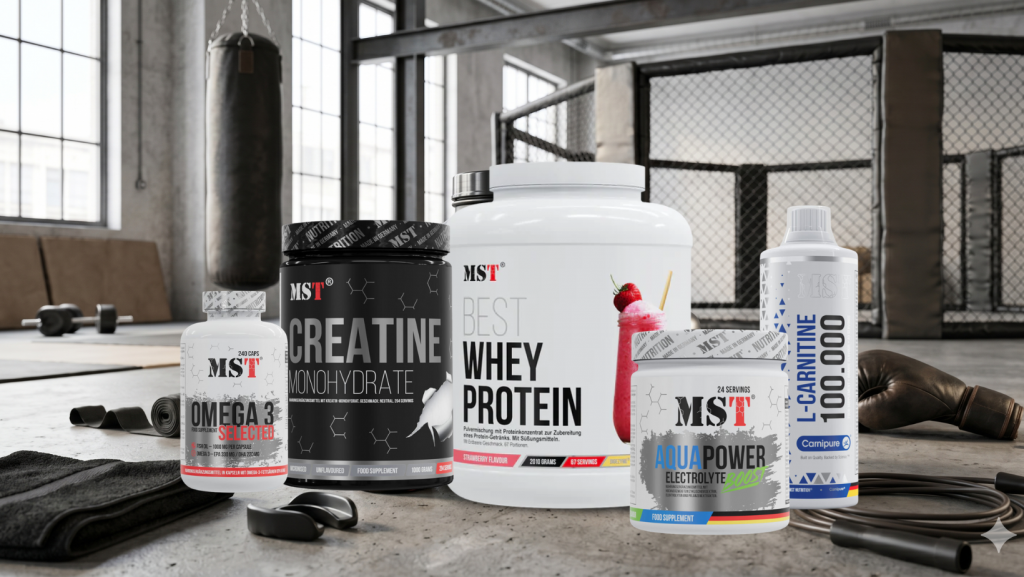
For most athletes who train seriously but without extremes, it is enough to assemble their stack around a few proven categories. This is protein to top up protein, creatine for strength and power, electrolytes for hydration, omega-3, and micronutrients for health and recovery. Further, as needed, amino acids, collagen, pre-workout formulas, or specialized complexes are added.
It is this approach that distinguishes systemic preparation from impulsive purchases. Flawless product quality, a transparent composition, and a clear task are always more important than flashy marketing. If a brand works with strict production standards, tests formulas, and focuses on real sports tasks, this is already a serious advantage. In this sense, the approach of MST® Nutrition Ukraine fits well with the expectations of fighters who value German quality, results, and clear sports logic.
Common mistakes because of which supplements do not work
The first mistake is to expect a result without a basic diet. If you are under-eating protein, eating chaotically, sleeping little, and constantly breaking down into fast food after an evening workout, no complex will cover these failures.
The second is to copy the schemes of professionals without taking into account your own workload. What works for a fighter in a training camp with two workouts every day is not always needed by a person with three sessions a week and an office job. The dose, time of intake, and set of products always depend on the context.
The third is to ignore digestion and individual tolerance. If you get heaviness from a certain protein, and a pre-workout makes your heart rate shake, the problem is not in your “weakness”. The formula simply doesn’t suit you. In combat sports, GI comfort is critical, especially before sparring and intense wrestling.
When the result is truly felt
Properly selected sports nutrition is felt not only in the numbers on the scale. You handle the volume of work better, enter the training rhythm faster, sag less between rounds, and recover easier after hard days. This is not a show effect, but a sporting advantage that accumulates week after week.
In MMA, the winner is not the one who takes the most supplements, but the one who removes weak spots in preparation. Start with the base, select products for your own goal, monitor the body’s reaction – and let each workout work for your result, and not just take away your strength.