 +38 050 933 51 60
 +38 093 369 29 10
When training becomes a system rather than a random trip to the gym, the question of supplements ceases to be secondary. Sports nutrition for bodybuilding is not magic or a short cut, but a tool that helps to more accurately close the needs of muscles, recovery, and progress in strength and body composition.
In bodybuilding, the result always rests on three pillars: the training program, the basic diet, and recovery. If at least one of them sags, even the most expensive formulas will not give the effect the athlete expects. That is why a strong approach starts not with a tub on the shelf, but with an understanding of the goal: whether you are gaining mass, cutting, working on strength, or trying to retain muscle in a calorie deficit.
What sports nutrition gives for bodybuilding
The main advantage of supplements is that they simplify the precise dosing of key nutrients. Getting the protein norm only from food is realistic, but not always convenient. The same applies to creatine, omega-3, or individual amino acids, which are needed during specific periods of increased workload.
Bodybuilding places high demands on the body. During mass gain, it is necessary to cover the increased need for calories and protein. During cutting, the task is different – to retain muscle tissue, control appetite, maintain work capacity, and not fall apart in terms of recovery. Therefore, the same scheme does not work for everyone.
Quality sports nutrition is also valued for its predictability. You know how much protein, creatine, or other active substances you get in each serving. For an athlete who thinks in terms of progress, this is critical. Flawless quality, clean composition, and a clear formula always win over random decisions.
The basic set: where to start
If you remove the marketing noise, most bodybuilders have a few truly working categories. They form the basis, and everything else is already selected for the task, experience, and the body’s reaction.
Protein
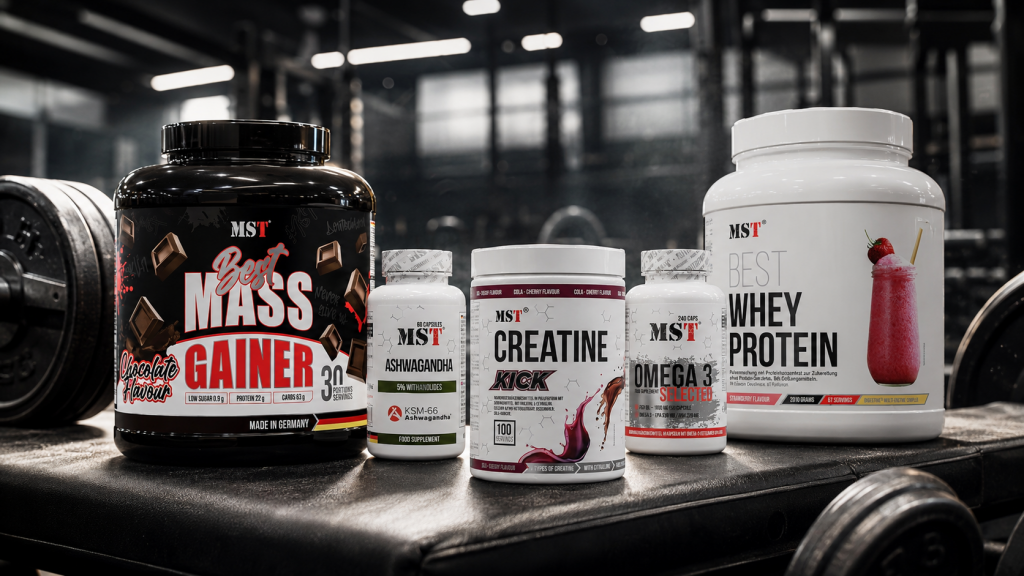
Protein is the first product it makes sense to start with. It does not replace regular food, but it helps to reach the daily protein norm without extra hassle. For gaining muscle mass, this is especially convenient when the appetite can no longer handle another full meal. For cutting – when you need to give the body protein without extra fats and carbohydrates.
Whey protein is usually chosen after a workout or at any time of the day when a fast and light source of protein is needed. Casein is more often used in the evening if longer satiety is important. If there is sensitivity to lactose or digestion peculiarities, the protein format will have to be selected more carefully.
Creatine
Creatine monohydrate is a classic that stays at the top not because of fashion, but because of the result. It helps with strength indicators, increases productivity in short intense sets, and often positively affects the gain of lean mass due to better training output. Champions recommend it not because it is a loud trend, but because it is one of the most proven supplements in sports nutrition.
Expecting an instant transformation from creatine is not worth it. Its strength lies in the cumulative effect and stability. If a person trains chaotics and eats somehow, they might see almost no difference.
Amino acids, BCAAs and EAAs
Honesty is important here. If you have enough protein in your diet, BCAAs are not always a priority purchase. But during periods of cutting, morning workouts on an empty stomach, or a high volume of workloads, they can be appropriate as a supporting tool. EAAs often look more practical because they contain a full set of essential amino acids.
That is, it is not a story about being mandatory for everyone. It is a story about appropriateness in a specific regime.
Pre-workout complexes
A pre-workout can give focus, energy, and better involvement in the work, especially when the training falls on an evening after a hard day or on a period of strict calorie deficit. But discipline is needed here. If there are problems with sleep, blood pressure, or oversensitivity to stimulants, such a formula can give more minuses than pluses.
A strong athletic approach is not to look for the harshest stimulus, but to look for your effective dose without crashing on recovery.
Vitamine, omega-3 and joint support
Bodybuilding strains not only muscles. Ligaments, joints, the nervous system, sleep, immune response – all this is also part of progress. That is why multivitamins, omega-3, magnesium, collagen, and joint complexes should not be perceived as something secondary.
Organic ingredients, quality raw materials, and production control have a special weight here. When you use supplements regularly, the question of purity and standardization comes to the fore.
How to select sports nutrition for your goal
If your goal is gaining mass
In this case, a calorie surplus, a sufficient amount of protein, and progression of workloads are at the center. Most often, the base looks simple: protein, creatine, vitamins, omega-3. If it is difficult to get calories with food, more caloric mixtures can come in handy, but here you need to monitor the quality of the composition, and not just the calorie figure.
Gaining mass does not mean an uncontrolled excess. If nutrition flies into chaos, extra fat quickly comes along with the muscles. Good sports nutrition supports cleaner and more manageable progress.
If you are cutting
On a cut, priorities are different: to retain muscles, maintain training intensity, and not fail in well-being. Here, protein, EAAs or BCAAs if necessary, omega-3, sleep support, and recovery become especially valuable. Fat burners can be a supporting tool, but not the basis of the result.
The most common mistake on a cut is to hope that one aggressive supplement will compensate for a too strict deficit and poor planning. It doesn’t work that way. When calories are cut too sharply, strength, muscle volume, and recovery suffer.
If the priority is strength and performance
Here, creatine, pre-workout complexes with an adequate composition, electrolytes, and recovery products come to the fore. But even in a strength cycle, protein and micronutrients have not been canceled by anyone. A muscle grows not only from the barbell, but also from whether the body has the resources to adapt to the workload.
Mistakes because of which supplements do not work
Most often, the problem is not in the product, but in expectations and the regime. Someone takes five or six positions at once without understanding why each of them is needed. Someone saves on quality and chooses only by a bright label. Someone drinks protein but does not reach the total calorie intake, and then wonders why the mass stands still.
Another typical mistake is to ignore regularity. Sports nutrition for bodybuilding gives a result when it is used systematically, within a program, and not from time to time. Strength, form, and recovery love discipline more than loud promises.
Also, do not copy another athlete’s scheme one-to-one. Weight, experience, training intensity, sensitivity to stimulants, work schedule, sleep, and even appetite – all this affects the choice. What worked perfectly for a competitive bodybuilder may turn out to be unnecessary or inconvenient for a person who trains four times a week and works in an office.
How to distinguish a strong product from a mediocre one
The premium segment in sports nutrition is justified when there are real advantages behind the price: a transparent composition, clear dosages, quality control, reliable production, good solubility, taste, and a stable result in use. If a formula is overloaded with beautiful words but does not give clear logic on ingredients, this is a weak signal.
For the Ukrainian market, trust in the manufacturer is especially important. When a product has a strong reputation, European production standards, and an orientation toward real sports tasks, the choice becomes simpler. That is why MST® Nutrition Ukraine relies on German quality, working formulas, and categories that help an athlete buy for a goal, not at random.
When supplements are already enough
There is a simple criterion. If you close the protein, keep calories for the task, sleep well, progress in workloads, and do not have obvious failures in recovery, you do not need to complicate the scheme endlessly. Sometimes two or three accurately selected products give more than a whole shelf of tubs.
Results in bodybuilding love precision. Not the maximum amount of supplements, but the right combination for your regime, your goal, and your responsibility in the gym and in the kitchen. If you treat it exactly like this, sports nutrition ceases to be just an expense and becomes a real part of progress.