 +38 050 933 51 60
 +38 093 369 29 10
Muscles do not grow from a large number of jars on the kitchen shelf. They grow when there is a calorie surplus, enough protein, heavy workouts with progression, and quality recovery. That is why an example of a mass gainer stack should be built not around the most expensive supplements, but around components that actually meet the athlete’s needs.
A stack is a well-thought-out combination of products for a single goal. During the gaining period, it should help you get enough calories and protein, support strength performance, and speed up recovery between workouts. If the diet is chaotic and sleep lasts five hours, even premium sports nutrition will not compensate for these gaps. But with the right base, it makes progress more stable and convenient.
Where Quality Mass Gaining Begins
The first point of reference is not the number on the scale, but the dynamics of the body, strength results, and measurements. For most athletes, a surplus of about 200–400 kcal per day will be sufficient. A more aggressive excess can increase weight faster, but often a significant part of the gain will be fat tissue and water.
Protein should be kept within 1.6–2.2 g per kilogram of body weight per day. Carbohydrates provide the resource for heavy sets, and fats are needed for a normal hormonal background and general health. When these three components are in place, supplements stop being a random purchase and become a working tool.
Do not confuse a mass stack with a stack for “lean” muscle gain without a single extra calorie. The quality of the gain depends on the accuracy of the surplus, activity during the day, genetics, and training experience. A beginner can add muscle faster, while an experienced athlete will have to work patiently for the sake of a few hundred grams of quality tissue per month.
Example of a Mass Stack: A Basic Working Scheme
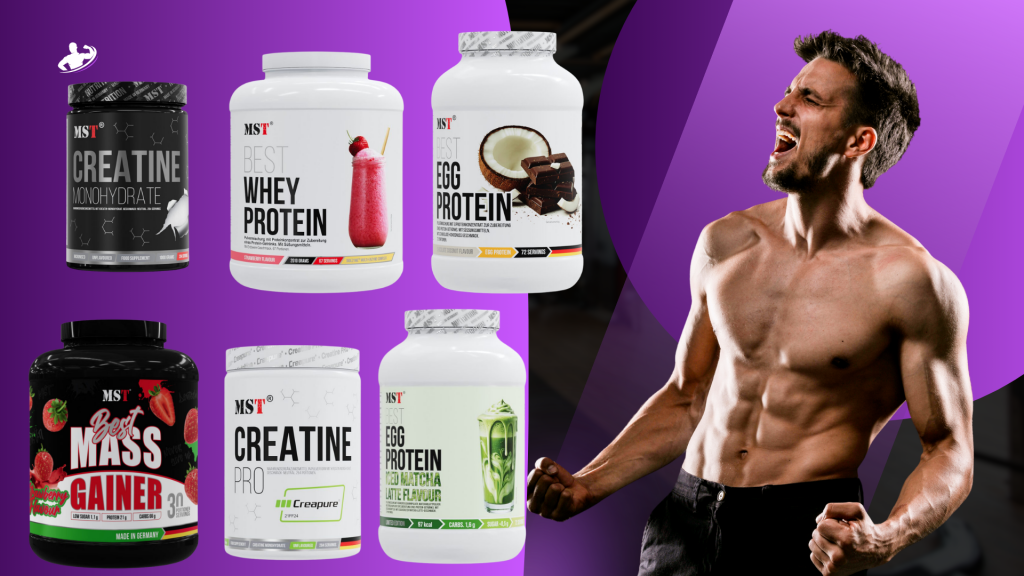
For an athlete who trains 3–5 times a week and has already sorted out their nutrition, a basic stack may consist of protein, creatine monohydrate, a gainer or carbohydrate blend if necessary, and omega-3s. This is not a maximum list, but a functional foundation without duplicating the action of products.
Protein to Meet the Protein Requirement
Whey protein is not a substitute for a full meal. Its strength lies elsewhere: it allows you to quickly and tastily close a protein deficit after a workout, on the road, or between meals. One serving usually provides about 20–25 g of protein, but the exact dosage depends on the composition of the specific product.
If you are already getting the required amount of protein from meat, fish, eggs, dairy products, and legumes, a shake is not mandatory. However, in practice, it is often what removes the problem of “missing 30 grams to meet the norm.” After a workout, you can mix protein with milk, a banana, or oat flour — this will add calories and carbohydrates without complex preparation.
Creatine for Strength and Volume of Work
Creatine monohydrate is one of the most researched sports supplements for strength sports. It supports the rapid recovery of energy stores in short, intensive loads. Simply put, it can give you the opportunity to perform a few more quality repetitions, better maintain working weights, and gradually increase training volume.
The standard scheme is 3–5 g daily, including rest days. The time of intake is not crucial; regularity is more important. A loading phase is optional, and a slight weight gain at the start is often associated with water retention inside muscle cells, rather than fat gain.
Creatine will not replace leg workouts, basic movements, and load progression. However, it complements them well. Choose pure monohydrate with a transparent composition and stick to the recommended serving.
Gainer, When Food Cannot Keep Up with Appetite
A gainer is not suitable for everyone. If you gain weight easily or have a tendency to accumulate fat, it is better to control calories through regular food and protein shakes. But for an ectomorph, an athlete with a high energy expenditure, or a person with a very tight schedule, a gainer can be a practical solution.
Its task is not to “turn on” anabolism, but to provide a convenient portion of calories, protein, and carbohydrates. Start with half a serving and track your weight over two weeks. If the gain exceeds approximately 0.25–0.5% of body weight per week, the calorie content should be slightly reduced.
An alternative to a ready-made gainer is a homemade shake made of protein, oatmeal, a banana, peanut butter, and milk or a plant-based beverage. It allows you to control the composition more precisely, though it requires more time.
Omega-3 for Recovery and Health
Gaining mass is not just about biceps and bench press numbers. Joints, the cardiovascular system, and overall well-being determine how consistently you will be able to train for months. Omega-3s can be a useful addition to the diet, especially if fatty sea fish rarely appears on the menu.
Look not only at the total weight of the capsule, but at the EPA and DHA content. If you have chronic conditions, take anticoagulants, or before surgery, the intake schedule should be discussed with a doctor.
Are BCAAs, EAAs, and a Pre-Workout Complex Needed?
BCAAs make sense primarily when the total amount of protein in the diet is insufficient or training takes place on an empty stomach. If you regularly consume complete protein and whey protein, separate BCAAs will not become a key growth factor. EAAs have a broader amino acid profile, but they also should not displace normal nutrition.
A pre-workout complex can increase concentration and readiness for a heavy session thanks to caffeine and other active components. This is useful before a morning workout or during a period of high load, but you should not take stimulants late in the evening. Sleep is one of the main anabolic resources, and no pre-workout is worth regular insomnia.
Testosterone boosters should also not be the base of a stack for a healthy athlete. Before looking for a complex formula, check your sleep, stress levels, caloric intake, fat content, and training regularity. This is usually where the cause of a plateau is hidden.
How to Distribute Supplements Throughout the Day
There is no need to turn the intake of sports nutrition into a ritual with a stopwatch. Take protein when it is easier to meet your protein requirement. Creatine — at any convenient time every day, for example, along with breakfast or after a workout. It is logical to use a gainer between meals or after the gym if extra calories are needed. Omega-3s are usually more comfortable to take with food containing fats.
On a training day, the priority looks like this: a full meal 1.5–3 hours before the gym, water during the session, and after — protein and carbohydrates in a convenient format. On a rest day, the stack is not canceled: muscles recover at this exact time, so creatine and meeting the daily protein requirement remain relevant.
Typical Mistakes That Slow Down Results
The most common mistake is buying a gainer and continuing to eat insufficiently. The second is changing the entire stack every week, without giving the body and the training program time to adapt. The third is focusing only on weight: if the waist grows faster than strength indicators and muscle measurements, the surplus is probably too large.
Also, do not copy the scheme of a professional bodybuilder. Their body weight, volume of work, diet, medical support, and experience can differ cardinally from yours. A quality stack is always tailored to a real need, rather than a loud product name.
At MST Nutrition Ukraine, the foundation of the mass gain category consists of solutions with a clear purpose: protein to meet the requirement, creatine for strength performance, carbohydrate formulas for calorie intake, and products for recovery. Choose supplements based on composition, dosage of active components, and your own program, rather than just a bright label.
Start with the simple things: for two weeks, record your nutrition, weight, sleep, and working weights. After that, your stack will stop being a guess and will become precise support for a stronger, bigger, and more enduring body.