 +38 050 933 51 60
 +38 093 369 29 10
When recovery after a workout drags on, joints remind you of themselves already during the warm-up, and concentration “floats” in the middle of the day, the question “omega 3 what for” becomes not theoretical, but very practical. This is not a trendy supplement “for everyone and for no one.” It is one of the basic nutrients that affects overall well-being, athletic form, and the quality of recovery.
Omega 3 what is it needed for in the body
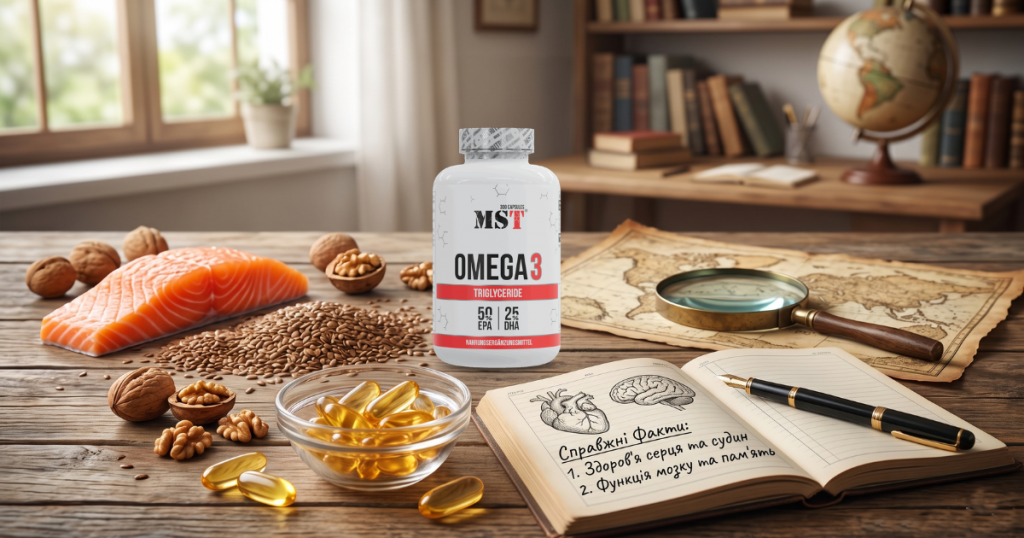
Omega-3 is not a single substance, but a group of polyunsaturated fatty acids. The most significant are EPA and DHA. It is they that participate in the functioning of the cardiovascular system, support of the brain, vision, joints, skin, and control of inflammatory processes.
For athletes and people with an active lifestyle, this topic is especially relevant. High loads, lack of sleep, a strict diet for cutting or gaining mass — all this increases the demands on recovery. And here omega-3 is valued not for loud promises, but for its real physiological role.
The body does not synthesize omega-3 in the required amount on its own. This means it must be obtained from food or from a high-quality supplement. If fatty marine fish rarely appears in the diet, a deficiency is highly likely.
For the heart, blood vessels, and inflammation control
One of the main reasons why people take omega-3 is to support the heart and blood vessels. EPA and DHA help maintain a normal lipid profile, positively affect the elasticity of blood vessels and the general state of the cardiovascular system.
This is important not only for older age. If you regularly train, work at a high pace, use pre-workout stimulants, or simply live in a state of constant stress, basic heart support matters. A strong body begins not with records in the gym, but with systems that withstand the load every day.
Separately, it is worth mentioning inflammatory processes. After intense workouts, micro-inflammation is a normal part of adaptation. But when the inflammatory background becomes too high, recovery slows down. Omega-3 does not replace sleep, protein, and a well-designed program, but it can be an important part of the recovery strategy.
Omega 3 what for in sports and fitness
In the sports environment, omega-3 is often underestimated because it does not give an instant effect like a pre-workout or caffeine. But it is precisely such supplements that often work “over the long haul.”
For those who train regularly, omega-3 can be useful in several directions. First, it is the support of joints and ligaments, which is important for strength loads, running, crossfit, and martial arts. Second, it is help in recovery after intense work. Third, it is the general support of the nervous system, which affects concentration, sleep quality, and the feeling of having resources.
Does this mean that omega-3 will automatically increase strength or “pump up” muscles? No. Its strength is not in a direct anabolic effect. Its advantage is in creating better conditions for stable progress. Less systemic overload, a better base for recovery, more control over daily resources.
For athletes on a cut, omega-3 is also valuable. When calories are reduced, and the total amount of fats in the diet often drops, it is easy to lose the balance of essential fatty acids. In this case, a high-quality supplement becomes not a luxury, but a smart solution.
Benefits for the brain, concentration, and vision
DHA is structurally important for the brain and eyes. That is why omega-3 is often recommended not only to older people but also to those who work with their heads, spend a lot of time in front of a screen, study, or make decisions under pressure.
If you combine training with work, business, or an intense schedule, quality concentration is also productivity. The problem is not always motivation. Sometimes it is a matter of recovery, routine, and basic nutritional support.
Here it is important to maintain a realistic approach. Omega-3 does not turn a person into a focus machine in one day. But with regular intake and a normal diet, it can support cognitive endurance and overall well-being.
Skin, hair, joints — not just about aesthetics
Many people start getting interested in omega-3 because of dry skin, discomfort in joints, or a desire to improve their appearance. This is logical. Omega-3 participates in the support of cell membranes, and therefore affects the condition of the skin, barrier functions, and general comfort.
For actively training people, joint health is not a secondary issue. If knees, elbows, or shoulders are constantly overloaded, progress quickly slows down. Of course, omega-3 alone will not fix the consequences of poor technique or chronic overload, but as part of comprehensive support, it is appropriate.
From a wellness perspective, this is also a strong argument. Feeling good is visible on the outside. When the body does not work “dry,” it is often reflected in both skin condition and general tone.
To whom omega-3 is especially relevant
There are categories of people for whom the question of “omega 3 what for” requires almost no additional proof. These are those who rarely eat fatty fish, train 3–5 times a week or more, follow a diet with a reduced fat content, have a high level of stress, or want to support the heart, joints, and cognitive functions.
Also, omega-3 is often chosen by people who rely not on a short-term effect, but on a quality base. This is the approach of champions — first cover the foundation, and only then look for minor advantages.
However, there are nuances. If you have medical conditions, take anticoagulants, or have other health characteristics, it is worth clearing the supplement with a doctor. A strong result begins with a smart approach, not with a random collection of jars.
How to choose omega-3 without a mistake
On the label, it is important to look not just at the words “fish oil,” but at the content of EPA and DHA. It is they that determine the value of the product. Two capsules from different jars may look identical, but the actual amount of active fatty acids in them will be different.
The second point is the purity of raw materials and production standards. For the premium segment, this is fundamental. Flawless quality means control of the fish origin, purification of raw materials, stability of the formula, and clear labeling.
The third criterion is the convenience of intake. If the dosage is inconvenient, people often miss the intake, and irregularity negates the benefit. It is better to choose a format that is easy to integrate into a daily routine.
That is why many buyers in Ukraine focus on brands with a clear reputation, transparent composition, and clear specialization in sports and wellness nutrition. In this segment, trust is built not by advertising, but by a stable result.
How to take omega-3 so that it makes sense
Most often, omega-3 is taken daily with food. This way, absorption is usually better, and gastrointestinal discomfort occurs less frequently. The specific dosage depends on the goals, diet, and concentration of EPA and DHA in the product.
For basic support, there is one need; for people with high loads, there is another. That is why it is important to orient yourself not by abstract “1-2 capsules,” but by the actual amount of active components per serving.
No less important is regularity. Omega-3 does not work according to the scheme “remembered — took it.” This is a story about consistency. If you approach training rules with discipline, it is logical to treat basic supplements the same way.
What you shouldn’t expect from omega-3
A strong product does not need exaggerations. Omega-3 does not burn fat by itself, does not replace a balanced diet, and does not override the effects of lack of sleep, alcohol, or chaotic workouts. If someone promises a magical result, this is no longer expertise, but marketing noise.
The real value of omega-3 is different. It supports the systems on which form, endurance, recovery, and overall well-being depend. This is not a “wow effect” for one day, but an investment in the stability of the result.
Therefore, the approach should be mature and athletic: evaluate your diet, understand the tasks, choose a quality product, and take it consistently. This is exactly how nutraceutical support works, giving a tangible meaning.
To put it bluntly, omega-3 is one of those supplements that do not scream about themselves, but often noticeably strengthen the base. And when the base is strong, everything else — from training progress to daily well-being — also becomes stronger. This is exactly what a smart choice is built on, yielding results not in words, but in the real rhythm of life.