 +38 050 933 51 60
 +38 093 369 29 10
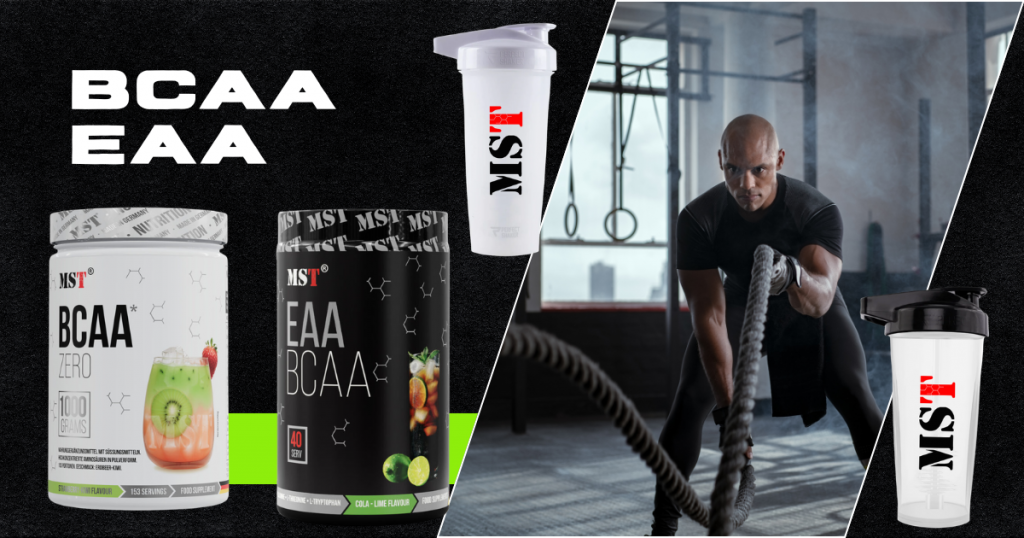
When workouts become truly serious, the question of whether eaa or bcaa is better ceases to be just a theory. It directly affects recovery, muscle growth, endurance, and whether you get a real effect from the supplement rather than just another jar on the shelf. Briefly speaking, BCAA is a narrow tool, while EAA is a more complete solution. But the right choice lies precisely in the details.
EAA or BCAA – which is better in practice
BCAA represents three essential amino acids: leucine, isoleucine, and valine. They are well-known in sports nutrition because leucine is directly linked to triggering muscle protein synthesis, and the entire trio is useful during exertion and in the recovery period.
EAA includes all the essential amino acids that the body cannot synthesize on its own. In addition to BCAA, histidine, lysine, methionine, phenylalanine, threonine, and tryptophan are added here. This is why EAAs look stronger from a physiological standpoint: to build new muscle structures, the body needs not only a trigger signal but also a full set of building material.
Here is the main point that is often ignored in advertising. BCAAs can stimulate the process, but if other essential amino acids are lacking, the effect will be limited. EAAs work more comprehensively in this sense. For an athlete who wants to not just feel a pump or reduce fatigue, but to truly support anabolism and recovery, this is a significant difference.
What is the real difference between EAA and BCAA
If you strip away the marketing, the difference is simple. BCAA is a part of EAA. Not an alternative in the full sense, but a fragment of a larger system.
BCAAs are most often chosen in three cases: when basic support during a workout is needed, when there is an emphasis on the anti-catabolic effect during cutting, or when a person is simply used to the classic product. It is a familiar format that has been at the top of sports nutrition for many years.
EAAs look more logical where the goal is broader: muscle mass gains, deeper recovery, high training frequency, calorie deficit, morning workouts on an empty stomach, or situations when a long time passes between meals. Under such conditions, a full amino acid profile provides more convincing support.
That means the answer to the question of whether eaa or bcaa is better depends on your task. If you need a minimal and more budget-friendly option, BCAAs can fulfill their role. If you need a product that better matches the modern understanding of recovery and muscle protein synthesis, EAAs usually win.
When BCAAs truly make sense
It would be a mistake to say that BCAAs are no longer needed. That is not true. It is just that they should be evaluated soberly.
BCAAs can be useful during long workouts, especially if you train in a calorie deficit or during a fat-loss phase. They also suit those who already get enough complete protein from food and protein powders but want additional support specifically around the workout. In such a scenario, BCAA is not a useless purchase.
Another advantage is simplicity. Some athletes tolerate BCAAs better in terms of taste and gastrointestinal comfort, especially during intense work in the gym, crossfit, or MMA sessions. If a supplement is easy to drink and does not interfere with the workout, this is also an important criterion.
But there is a nuance. If your diet is weak in protein, and you hope that BCAAs will fix the situation, that is a weak strategy. They replace neither complete protein nor a properly structured diet.
When EAA is a stronger choice
Today, EAAs look more convincing not because it is a fashionable trend, but because they better address the athlete’s tasks. When the body receives all essential amino acids, it has not only a signal for protein synthesis but also the resource for this synthesis.
EAAs show themselves particularly well in those who train frequently and heavily. If you have 4-6 sessions per week, including strength work, cardio, sparring, functional complexes, or high volumes, the question of recovery becomes no less important than the workout itself. Here, comprehensive support makes sense.
EAAs are also appropriate during a cutting phase. In a calorie deficit, the body is more sensitive to nutrient deficiencies, and the risk of losing muscle mass is higher. In such a phase, a full spectrum of essential amino acids looks stronger than a stake on just three amino acids.
That is why many coaches and experienced athletes are gradually shifting their focus from BCAA to EAA. This is not about loud promises, but about a more logical formula for results.
What is better for muscle gain, cutting, and endurance
For gaining muscle mass, EAAs are usually preferable. If the goal is to grow, the body needs a full set of amino acids. BCAAs can be an additional tool, but as primary amino acid support, they fall short.
For cutting, the choice is also frequently in favor of EAAs, especially if the calorie deficit is deep and workouts remain intense. At the same time, BCAAs have a right to a place if the budget is limited and you already cover your protein needs from other sources.
For endurance, the situation is not as clear-cut. If we are talking about long sessions, interval work, crossfit, or martial arts, BCAAs can help with the feeling of fatigue during exertion. But EAAs still look more versatile because they support both the work and the recovery after it.
To put it bluntly, BCAA is rather a targeted solution. EAA is more strategic.
How to choose without making a mistake
Start not with a jar, but with your own system. If you eat enough protein, use high-quality protein powder, and only want support around your workout, BCAAs can satisfy the request. If your schedule is tight, nutrition is not always perfect, and loads are high, EAAs will usually be a smarter choice.
Pay attention to the composition. In BCAAs, the ratio of amino acids is important, most often it is 2:1:1, and for most, this is the optimal classic variant. In EAAs, it is important that the profile is complete, without decorative dosages, and with a sufficient amount of key amino acids. A quality product is not just a bright label, but a formula that works under a load.
Also, do not confuse amino acids with protein. If you have a shortfall in overall daily protein, that is what needs to be fixed first. Amino acids should not mask a weak diet. They work best when embedded in a strong system: nutrition, sleep, training plan, and recovery.
For those who are used to buying sports nutrition for a specific goal rather than at random, this approach yields better results. This is exactly what expert choice is built upon – not taking what is popular, but taking what is appropriate.
EAA or BCAA – which is better specifically for you
If you are a beginner and just want to add something beneficial to your workouts, do not overcomplicate it. Look at your diet. If protein is low, fix that first. If everything is fine with protein, but the budget is tight, BCAAs can be a working start.
If you are already training systematically, working for mass, cutting, keeping a high volume, or combining several types of loads, EAAs look like a stronger solution. This is a more modern and complete support format that better meets the needs of a performance-driven athlete.
For many athletes, the answer is already obvious: EAAs more frequently provide more benefits due to a wider amino acid profile. But BCAAs are not disappearing from the arena, because in the right context, they work too. The question is not which product is advertised louder, but which product more precisely solves your task.
If you focus on clean ingredients, flawless quality, and formulas that correspond to real sports goals, this approach completely aligns with the philosophy of MST Nutrition Ukraine. Champions recommend not random solutions, but those that bring results.
A strong choice in sports nutrition almost always begins with an honest question to yourself: do I need just a popular product or a formula that will genuinely support my progress.