


 +38 050 933 51 60
 +38 093 369 29 10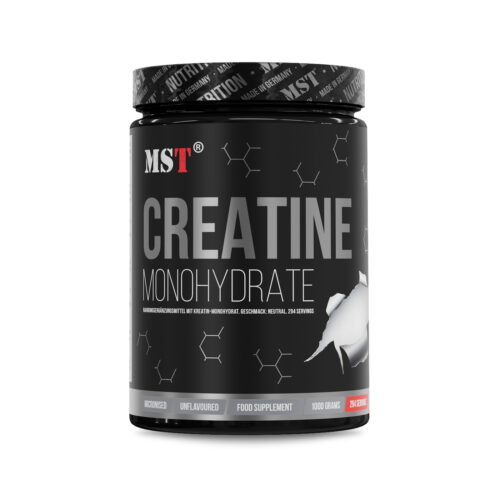


 ×
×Are you looking for the most effective sports supplement for muscle growth and increased strength? Creatine monohydrate is the gold standard, proven by time and scientific research. If you want to buy creatine monohydrate in Ukraine at the best price, our great offer from MST Nutrition is exactly what you need. We offer a wide range of products so you can achieve maximum results.
Unlike many other supplements, creatine has a powerful scientific basis that confirms its ability to enhance strength, increase muscle volume, and accelerate recovery. In our assortment, you will find only high-quality creatine that meets the needs of every athlete.
The scientific community unanimously recognizes creatine as one of the most effective sports supplements on the market. Numerous systematic reviews and meta-analyses confirm its safety and effectiveness.
The study by Volek et al., published in the Journal of the International Society of Sports Nutrition (2004), was dedicated to the effect of creatine on strength indicators. The goal was to investigate how creatine supplementation affects maximal strength and muscle endurance during resistance training. Participants who took creatine showed a significantly greater increase in bench press and squat performance compared to the placebo group. Over 12 weeks, their maximal bench press strength increased by 14%, which is a significant indicator. This effect is explained by the increased phosphocreatine content, which ensures rapid ATP synthesis. Researchers concluded that creatine is one of the most effective supplements for improving athletic performance. This study confirmed that creatine supplementation is critically important for athletes who aim to increase strength.
Source: Volek, J.S., et al. (2004). The effects of creatine supplementation on muscular performance and body composition. Journal of the International Society of Sports Nutrition.
The study by Kreider et al., published in Molecular and Cellular Biochemistry (2003), was one of the first to comprehensively examine the effect of creatine on athletes’ bodies. Its purpose was to evaluate the effect of creatine on body composition, strength, and muscle mass. Participants who took creatine along with resistance training showed a significant increase in lean muscle mass. On average, body mass gain was about 2 kg in the first 4-6 weeks of use. This occurs due to cellular hydration, which increases muscle fiber volume, and the enhancement of muscle protein synthesis. The results confirmed that creatine is an effective ergogenic aid for muscle building. This study is one of the key ones that proves a direct link between creatine intake and muscle hypertrophy.
Source: Kreider, R.B. (2003). Effects of creatine supplementation on performance and training adaptations. Molecular and Cellular Biochemistry, 244(1-2), 89-94.
The study by Poortmans and Francaux, published in Medicine & Science in Sports & Exercise (1999), refuted common myths about creatine’s harm to the kidneys. The purpose of the work was to assess whether long-term creatine intake affects kidney function in healthy athletes. The study involved athletes who took creatine at doses from 5 to 20 grams per day for several months. The results showed that no negative changes were found in kidney function indicators, such as creatinine levels or glomerular filtration rate. This confirmed that creatine is safe for healthy individuals. The researchers emphasized that in the absence of pre-existing kidney diseases, creatine intake does not pose a risk. This work is fundamental for confirming the safety of creatine monohydrate supplementation.
Source: Poortmans, J. R., & Francaux, M. (1999). Long-term oral creatine supplementation does not impair renal function in healthy athletes. Medicine & Science in Sports & Exercise, 31(8), 1108-1110.
The study conducted by Greenwood et al. and published in the International Journal of Sport Nutrition and Exercise Metabolism (2003) focused on creatine’s role in recovery. The goal was to find out how creatine supplementation affects muscle damage and inflammatory processes after intense exercise. Participants who took creatine had significantly lower markers of muscle damage (e.g., creatine kinase) after workouts. This indicates that creatine helps protect muscle cells from microtrauma. As a result, the time required for full recovery between training sessions is reduced. This is especially important for athletes who train at a high frequency. The study highlighted that creatine not only increases strength but also improves adaptation to physical stress.
Source: Greenwood, M. et al. (2003). Creatine supplementation and muscle damage: A review. International Journal of Sport Nutrition and Exercise Metabolism, 13(1): 96-107.
The study conducted by Rae et al. and published in Proceedings of the Royal Society of London. Series B: Biological Sciences (2003), investigated the effect of creatine on brain function. The goal was to test whether creatine intake could improve cognitive abilities, especially memory. Participants who received creatine supplementation showed a significant improvement in short-term memory and mental performance tasks. This effect was especially noticeable in conditions that required intense mental exertion, such as sleep deprivation. The mechanism of action is related to the fact that the brain, like muscles, uses creatine to maintain energy metabolism. The study confirmed that creatine can be beneficial not only for physical but also for mental performance.
Source: Rae, C. et al. (2003). Oral creatine monohydrate supplementation improves brain performance: a double-blind, placebo-controlled, cross-over trial. Proceedings of the Royal Society of London. Series B: Biological Sciences, 270(1529): 2141-2147.
The study by Candow et al., published in the journal Nutrients (2023), was dedicated to creatine’s role in combating age-related muscle mass loss. The purpose of the meta-analysis was to evaluate how creatine in combination with resistance training affects muscle strength and body composition in older adults. The analysis showed that creatine intake significantly enhances the increase in strength and lean mass in older individuals. This helps counteract sarcopenia—the progressive loss of muscle that often occurs with age. The researchers noted that the effect of creatine was minimal without regular physical exercise. This work confirmed that creatine is an effective tool for maintaining muscle health and functionality in later life.
Source: Candow D.G. et al. (2023). Effects of Creatine Supplementation and Resistance Training on Muscle Strength and Body Composition in Older Adults: A Meta-analysis. Nutrients, 2023.
The study by Burke et al., published in European Journal of Applied Physiology (2003), investigated how creatine affects vegetarians, who typically have low levels of creatine in their bodies. The goal was to compare the effect of creatine intake on muscle strength and creatine concentration in vegetarians and meat-eaters. Vegetarians showed a significantly greater increase in muscle creatine and strength. This result indicates that vegetarians may receive a special benefit from taking this supplement, as their bodies have a significant deficiency. The study also confirmed that creatine intake improves physical performance in both groups. This research is important for dietary recommendations for vegetarians who exercise.
Source: Burke, D. G. et al. (2003). Effect of creatine and weight training on muscle creatine and phosphocreatine in vegetarians. European Journal of Applied Physiology, 90(3-4): 332-337.
The main function of creatine is to accelerate the synthesis of ATP (adenosine triphosphate), which is the main energy source for muscle contractions. During high-intensity exercise (resistance training, sprinting), ATP stores are quickly depleted. Creatine helps to quickly replenish these stores, allowing you to perform more repetitions, lift heavier weights, and train with higher intensity.
This very mechanism provides a noticeable increase in strength and muscle mass within just a few weeks of regular use. By regularly replenishing creatine stores in your muscles, you provide your body with the “superfuel” necessary for maximum performance.
The effectiveness and safety of creatine monohydrate are confirmed not only by numerous studies but also by the unanimous position of leading medical and sports science organizations. Here’s what the experts say about this supplement.
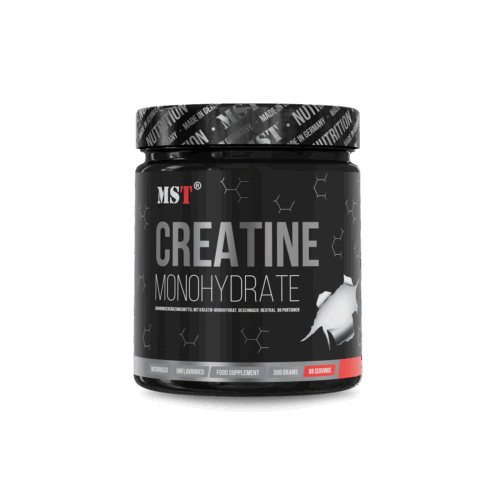
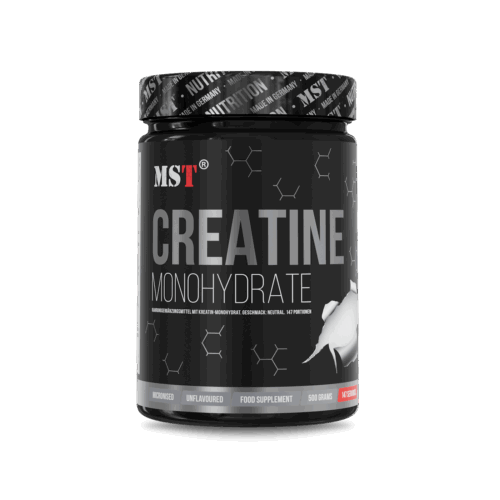
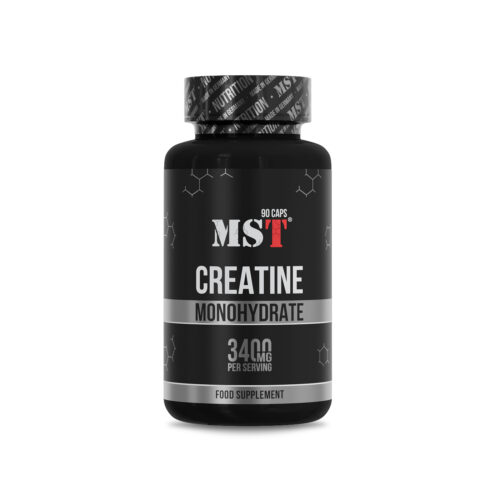
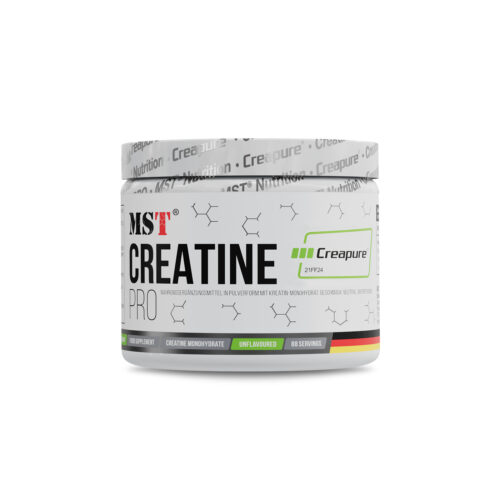
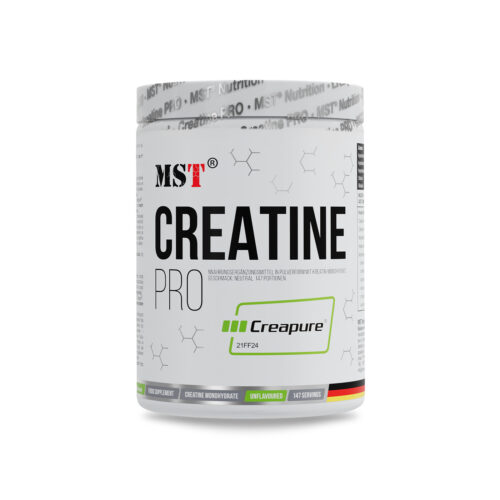
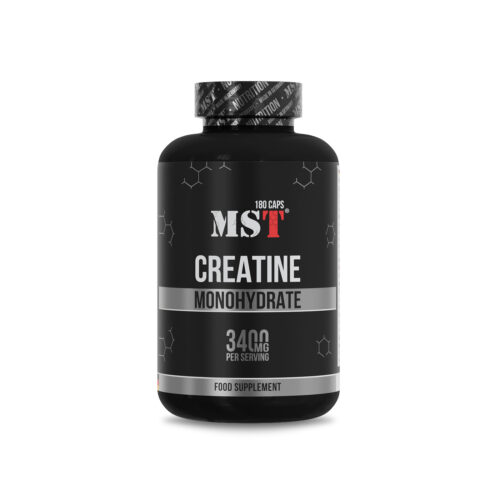
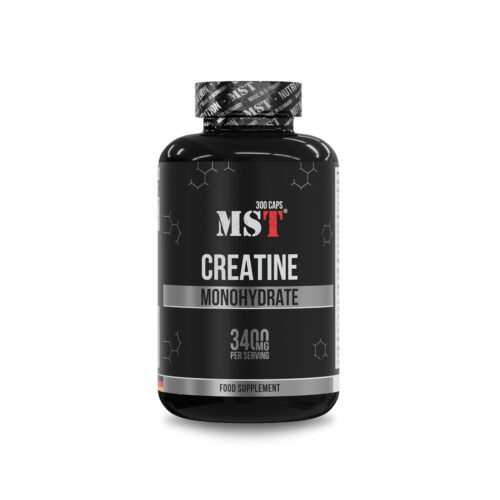
MST Nutrition offers several products in the creatine monohydrate category, each with its own features.
Our micronized creatine is the ideal choice for those who seek speed and efficiency. Thanks to micronization technology, creatine particles are very small, which ensures their instant absorption without stomach discomfort. It dissolves well in liquid and is flavorless, allowing it to be easily combined with protein shakes or juices.
If you value convenience and dosage accuracy, our capsules are your choice. They are easy to take anytime, anywhere, without the need to prepare powder mixtures.
For those who are looking for the purest and most effective creatine in the world, MST Nutrition offers products with German Creapure® raw material. This is a patented, vegan product, produced to the highest quality standards (GMP, HACCP, ISO) and certified by IFS FOOD. Thanks to the unique manufacturing technology, Creapure® guarantees high purity (over 88%) and a complete absence of impurities.
Creatine monohydrate is one of the safest and most researched sports supplements in the world. Most myths about its harm have been debunked by scientific studies. However, like any other supplement, it may have certain features and requires a responsible approach to its intake.
By choosing creatine monohydrate from MST Nutrition, you get not just a supplement, but a guarantee of quality. Our products are manufactured to high GMP standards, ensuring an optimal quality-to-price ratio. We offer only verified, pure products that will help you achieve your sports goals without unnecessary risks. To order creatine or find out the price of creatine, visit our website.
Order high-quality creatine from MST Nutrition right now! We will ensure fast delivery to Kyiv, Lviv, Kharkiv, Odesa, Dnipro, Zaporizhzhia, and other cities in Ukraine.
×