 +38 050 933 51 60
 +38 093 369 29 10
EAA vs. BCAA – Which is Better for Workouts? A Complete Analysis
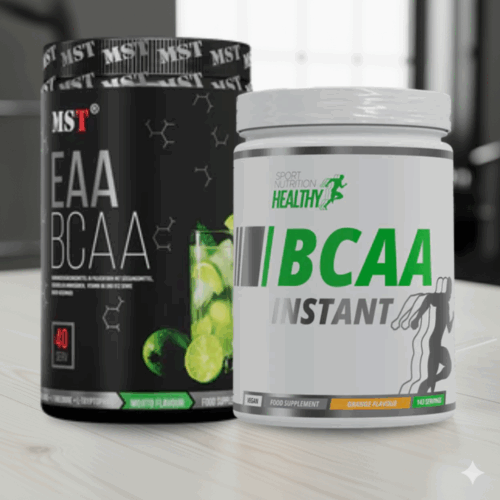
In the world of sports nutrition, amino acids hold a special place. Among the many supplements, two categories – BCAA (Branched-Chain Amino Acids) and EAA (all Essential Amino Acids) – raise the most questions for athletes. What’s better for workouts? Are both supplements necessary? How do they affect muscle growth, recovery, and performance? In this article, we will thoroughly examine the difference between EAA and BCAA, their benefits, and determine which supplement will be optimal for your specific goals. If you’re looking to buy EAA or buy BCAA for maximum effectiveness, this information will be your reliable guide.
What are BCAAs?
BCAA (Branched-Chain Amino Acids) are amino acids with a branched chain: leucine, isoleucine, and valine. They get their name from their unique chemical structure. Unlike most other amino acids, BCAAs are metabolized directly in the muscles, not the liver. This makes them especially valuable for athletes, as they quickly reach muscle cells during physical exertion.
Key functions of BCAAs:
- Stimulating protein synthesis: Leucine, a component of BCAAs, is a powerful activator of the mTOR signaling pathway, which plays a key role in muscle protein synthesis (Blomstrand et al., 2006). This means BCAAs directly contribute to muscle mass growth.
- Reducing muscle catabolism: BCAAs help prevent muscle tissue breakdown during intense workouts or calorie deficits by providing muscles with energy (Shimomura et al., 2004).
- Reducing fatigue: Valine and isoleucine can compete with tryptophan for entry into the brain, potentially reducing the production of serotonin, which causes fatigue during prolonged exertion (Newsholme et al., 1987).
What are EAAs?
EAA (Essential Amino Acids) are all nine essential amino acids that the body cannot synthesize on its own, so they must be obtained from food or supplements. These include: leucine, isoleucine, valine (i.e., BCAAs), as well as histidine, lysine, methionine, phenylalanine, threonine, and tryptophan.
Key functions of EAAs:
- Full spectrum for protein synthesis: For the complete synthesis of new proteins (and therefore for muscle growth and recovery), all nine essential amino acids are required (Wolfe, 2017). If even one is missing, the protein synthesis process can be disrupted.
- Supporting overall health: Each EAA plays a unique role in various biological processes, including hormone production, enzymes, neurotransmitters, and immune system support.
- Effectiveness in maintaining nitrogen balance: Sufficient EAA intake ensures a positive nitrogen balance, which is fundamental for anabolic processes in the body.
EAA vs. BCAA – Which is Better for Workouts? A Comparative Analysis
This is the main question on many people’s minds. To understand what’s better, let’s look at a few aspects:
- Muscle protein synthesis (MPS):
- BCAA: Leucine, a component of BCAAs, is known to be a powerful trigger for MPS. BCAAs can effectively initiate this process.
- EAA: However, for the continuation and complete completion of MPS, all essential amino acids are necessary. Studies show that EAAs are more effective at achieving maximum muscle protein synthesis because they provide the complete building material (Mochizuki et al., 2021). Without other EAAs, BCAAs can start the process but not sustain it for a long time.
- Recovery and reducing soreness:
- Both supplements help reduce muscle soreness after workouts (DOMS) and speed up recovery.
- EAAs, thanks to their complete profile, can provide more comprehensive recovery, as all amino acids participate in tissue regeneration and maintaining overall homeostasis.
- Energy during a workout:
- BCAAs can be used as a source of energy during long workouts, especially in cases of glycogen depletion (Shimomura et al., 2004).
- EAAs can also be metabolized for energy, but their main role is as building blocks.
Conclusion of the comparison:
According to modern scientific data, EAAs are considered a more complete and effective solution for stimulating muscle protein synthesis and overall recovery, as they contain all the necessary “building blocks.” BCAAs are certainly useful, but their effectiveness can be limited without the presence of other EAAs. If your diet is already rich in complete protein (meat, eggs, dairy products), you are likely already getting enough EAAs. However, if you are a vegan, follow a protein-restricted diet, or your goal is maximum muscle growth, then EAAs may be a higher priority.
When to take BCAAs and EAAs?
The timing of intake can affect the supplement’s effectiveness.
- BCAAs:
- Before or during a workout: To prevent muscle catabolism and provide muscles with energy.
- Between meals: To support anabolism, especially during long breaks between eating.
- EAAs:
- Before, during, or after a workout: Ideal for maximum stimulation of protein synthesis and recovery. Post-workout intake is especially important for quickly replenishing the amino acid pool.
- In the morning on an empty stomach: To prevent overnight catabolism and initiate anabolic processes.
Recommendations for choice
- If your diet contains a lot of complete protein: BCAAs may be sufficient for extra support during workouts or between meals.
- If you follow a vegetarian/vegan diet, or your protein intake is limited: EAAs will be a better choice, as they guarantee you get all the essential amino acids that may be missing in plant-based foods.
- If your goal is maximum muscle growth and fast recovery: EAAs offer a more complete anabolic profile.
- For fasted workouts: EAAs may be the better choice to prevent catabolism and maintain energy.
Where to buy BCAA and EAA?
If you have decided to buy BCAA or buy EAA to optimize your workouts, it is important to choose trusted suppliers.
For residents of Ukraine, we recommend checking out the wide range of products in major cities like Kyiv, Kharkiv, Odesa, Dnipro, Lviv, Zaporizhzhia, Kherson, and Chernihiv, as well as throughout the country:
For customers from Europe, German websites are available that ship to many countries and major cities, including Berlin, Paris, Rome, Madrid, Warsaw, Prague, Budapest, Vienna, and Lisbon:
Here you will find quality supplements that meet high standards of sports nutrition.
Conclusion
The question “EAA vs. BCAA – which is better for workouts?” does not have a single answer, as the choice depends on individual needs, goals, and diet. BCAAs are powerful stimulators of protein synthesis, while EAAs provide a complete spectrum of essential amino acids necessary for optimal recovery and growth. For most athletes aiming to maximize results, EAAs may be a more effective choice, especially if the diet has a deficit of complete protein. Always listen to your body and, if possible, consult a sports nutrition specialist.
References:
- Blomstrand, E., et al. (2006). Branched-chain amino acids activate key enzymes in protein synthesis after physical exercise. Journal of Nutrition, 136(1 Suppl), 273S-277S.
- Castell, L. M., et al. (1996). The effect of oral glutamine supplementation on the incidence of illness in athletes. European Journal of Applied Physiology and Occupational Physiology, 73(5), 488-490.
- Legault, Z., et al. (2015). The influence of L-glutamine on muscle strength and soreness following eccentric exercise. European Journal of Applied Physiology, 115(5), 979-985.
- Mochizuki, S., et al. (2021). EAA-containing beverage enhances muscle protein synthesis more than BCAA-containing beverage in healthy young men. Journal of Clinical Biochemistry and Nutrition, 68(1), 58-65.
- Newsholme, E. A., et al. (1987). The role of the BCAA in fatigue. Journal of Nutritional Biochemistry, 3(7), 241-255.
- Shimomura, Y., et al. (2004). Branched-chain amino acid supplementation before exercise improves carbohydrate and fat metabolism and reduces fatigue during exercise. Journal of Nutrition, 134(6 Suppl), 1583S-1587S.
- Wolfe, R. R. (2017). Branched-chain amino acids and muscle protein synthesis in humans: myth or reality? Journal of the International Society of Sports Nutrition, 14(1), 30.